So, I have at last got around to writing the final assessment of my camino, completed some ten weeks ago. I dont know why it has taken me so long to put fingers to keyboard. May be some deep psychological reason relating to not wanting to let go of the experience. Or may be just a case of laziness. Or more likely some wishy-washy reason somewhere inbetween. I apologise for the length of this post, which is a fairly thorough reflection of five very significant weeks in my life.
Daily life on the Camino
With the exception of only two nights we stayed in albergues along the route. Albergues provide a bed for one night only on production of a pilgrim’s credential which is rubber stamped and dated. The accommodation varies in cost from free (although a donation is expected), to 12 euros.
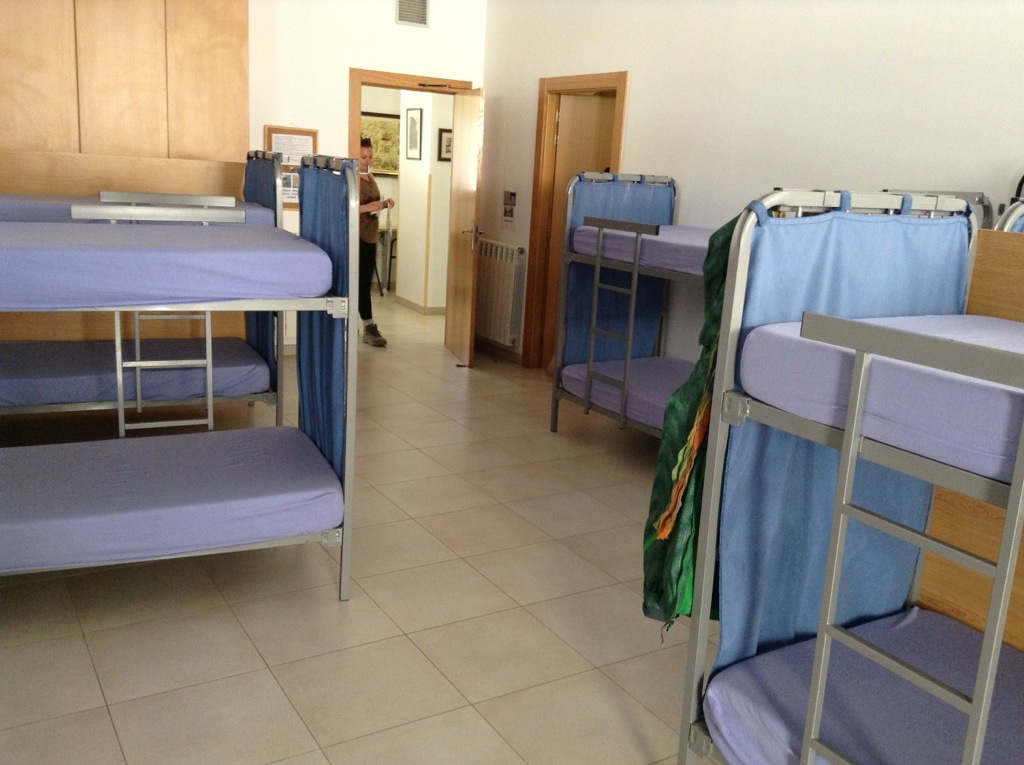
They are run by the local authority, or by the church, or privately. Conditions vary enormously from appalling to superb. In some there is room to swing a cat, and in others the beds are touching and you find yourself in extreme proximity to a complete stranger

Albergue Puerta Revellin, Logroño, spacious dormitory and excellent facilities
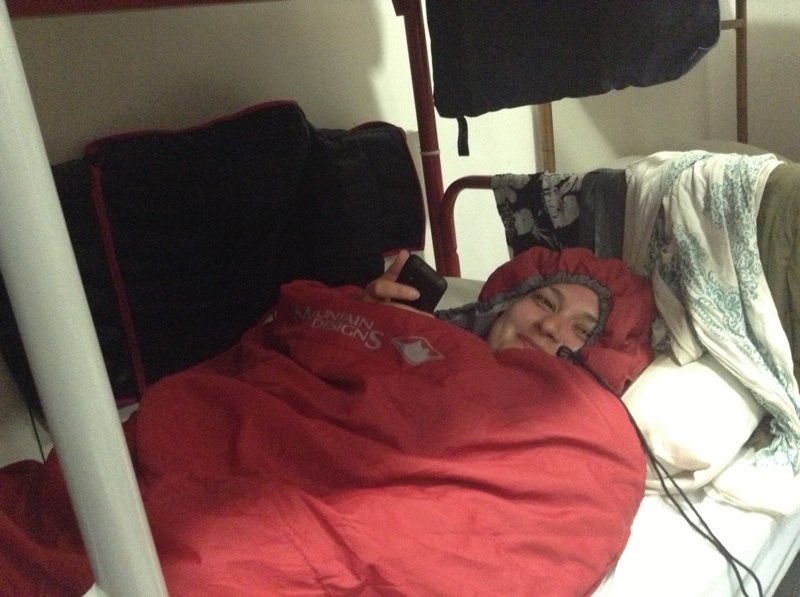
Beds are usually bunks, and an upper and lower bunk are allocated to pilgrims arriving in pairs. Ella was always gracious about taking the top bunk, but I did find myself sleeping up top on one occasion when there was no other option. Although clambering up a rickety ladder is rather ungainly, the advantage when reaching such heights is that you can actually sit on the bed without bending double. What I didn’t like about the lower bunk was that I could never be sure what debris might fall from the mattress above during the night.
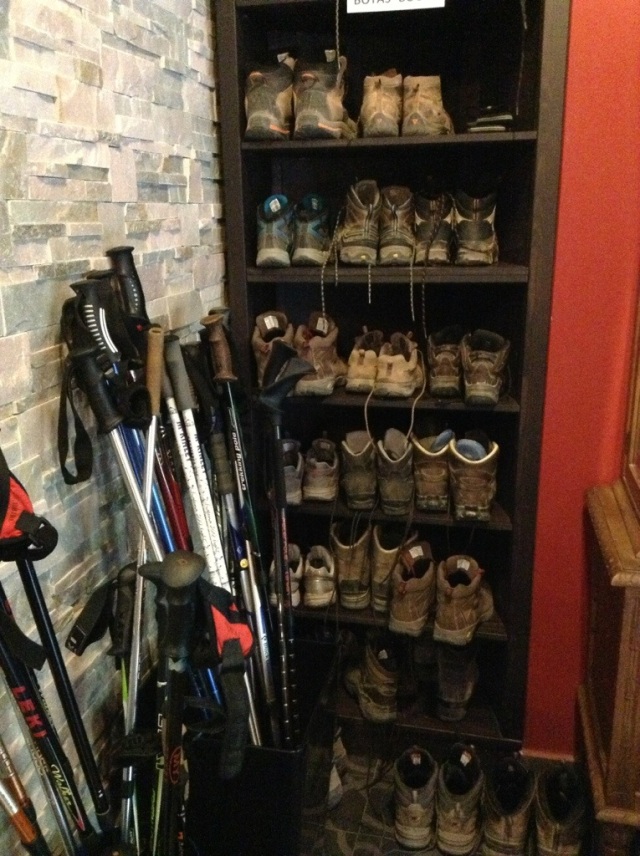
The very friendly and comfortable Albergue Puerta de Nájera
Some nights in the albergues it was very cold and I wore long johns and long sleeved t-shirt to bed, other nights it was really hot. Invariably the dormitories were extremely stuffy and a bit smelly by the morning and it was a relief to get up and go outside as soon as possible.

A bit chilly in Los Arcos, Albergue Casa de Austria, very friendy and cosy atmosphere
There was a lot of snoring in the dormitories but ear plugs drowned out most of the noise and enabled a reasonable night’s sleep.
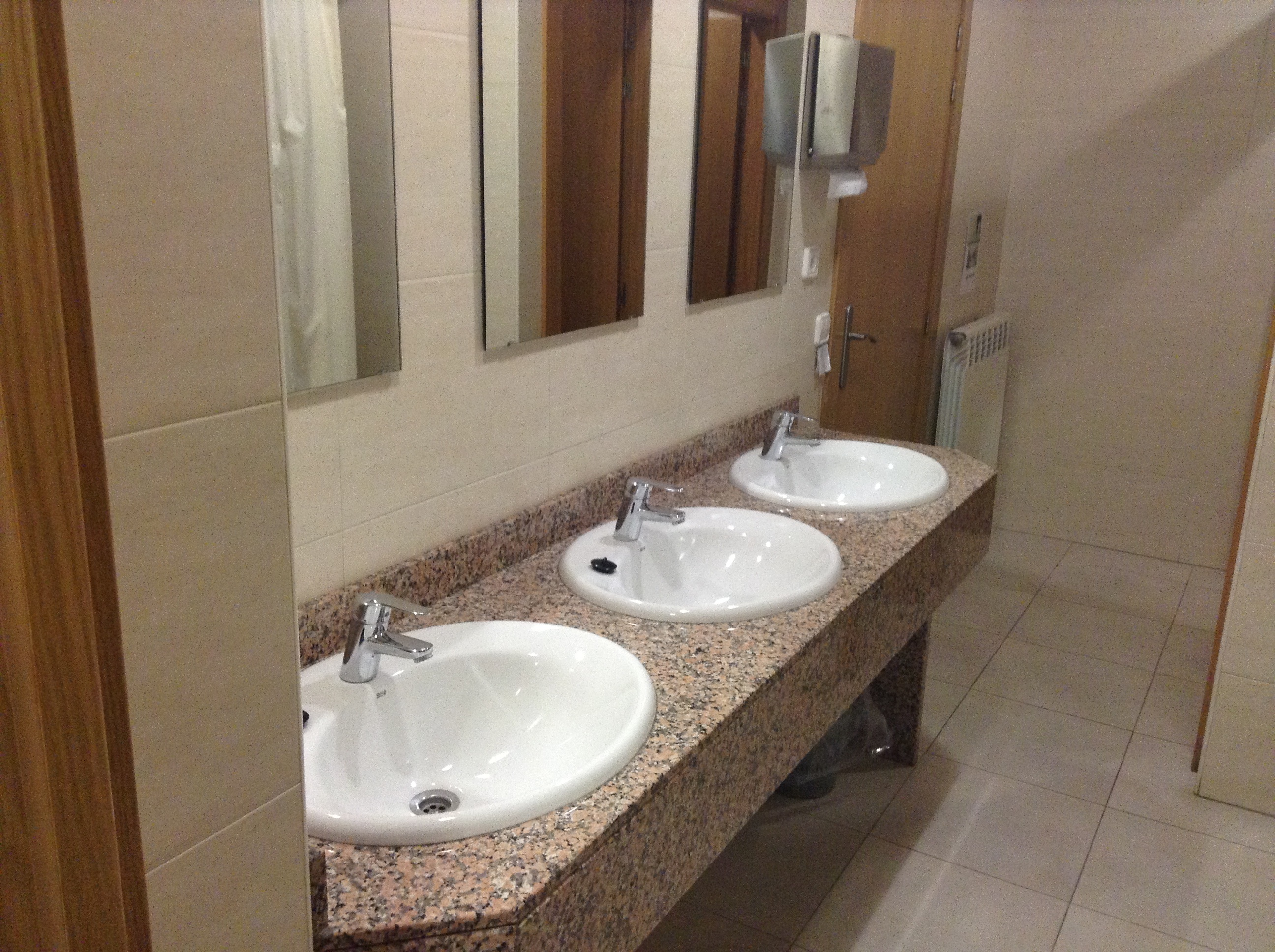
Although facilities were limited, there was rarely a problem queuing for the loo or shower. A lot of people left very early in the morning, way before it was light, so those of us that rose later – between 6:30 and 7:00 did not have such a problem.

Logroño , Albergue Puerta de Revellin
Life on the camino involved waking, packing, walking, stopping for breakfast after an hour or two, walking, stopping for lunch, walking, arriving at the albergue, showering, laundry, writing my blog, eating dinner, lights out between 9:30 and 10:30.
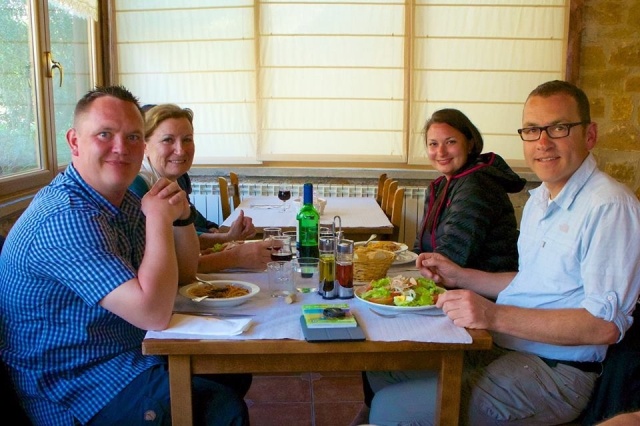
Albergue Camino del Perdon in Uterga which was full and we were charged an outrageous 50 euros for a double bedroom in a B&B owned by the albergue hospitaleros

The fabulous characterful albergue at Espinosa del Camino, where hospitalero Pepe cooks paella for supper
After a strong start I found the following days quite hard. I didn’t sleep well and felt exhausted a lot of the time. Whilst Ella, after her weak start, got stronger by the day.
We both suffered with blisters, despite my training. And the soles of my feet really ached at times.
But I slowly got to know my body. I seemed to have a low patch in the early afternoon when I just felt drained of energy and I needed a rest. I realised that I didn’t feel the stones through my boots in the mornings, just in the afternoons when my feet had become more sensitive.
About half way through the third week my feet were healed, I had no more blisters, and my boots became comfortable at all times
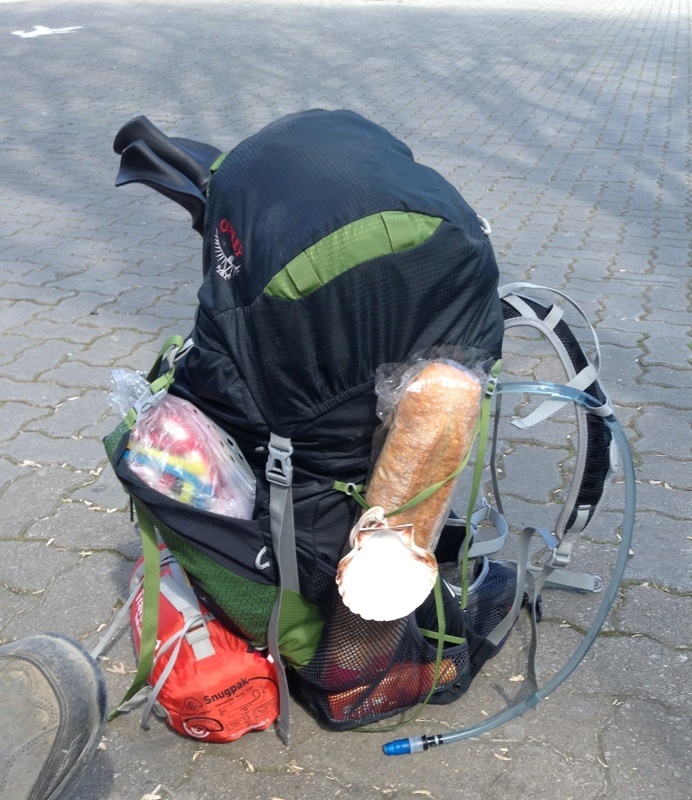
After starting off as a burden, my backpack became almost weightless at times, and I wasn’t at all aware of it. It was a surprise when I took it off and felt how heavy it actually was.

I became better at getting ready in the mornings. Initially I found it hard to organise my belongings into their rightful places and I had great difficulty stuffing my sleeping bag into its under-sized compression sack. But it all got easier with practise.
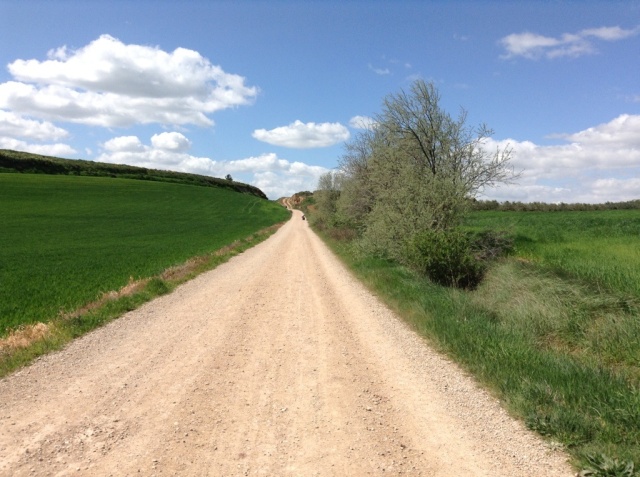
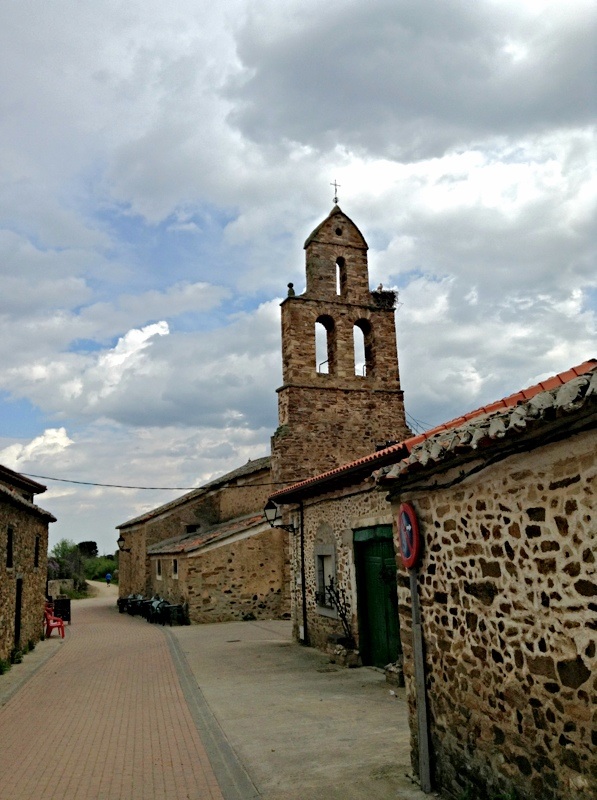
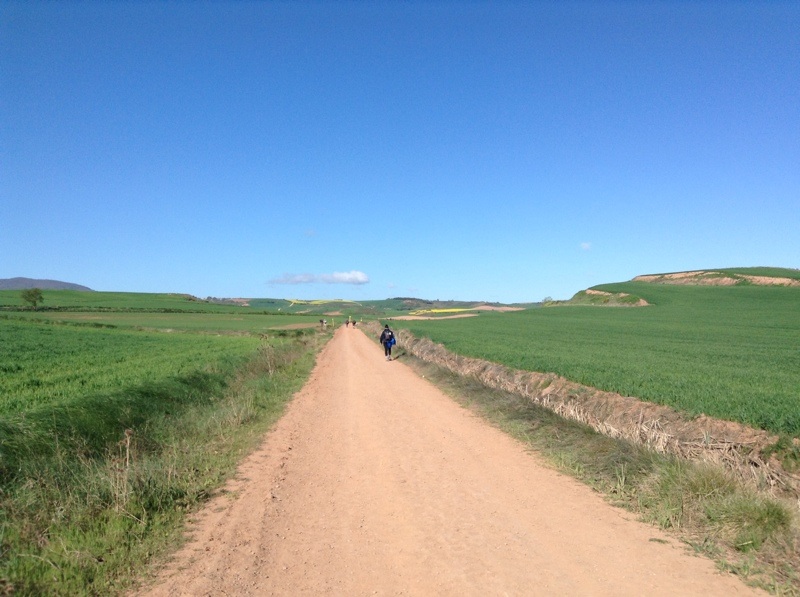
Some days the camino was populated by dozens of pilgrims,
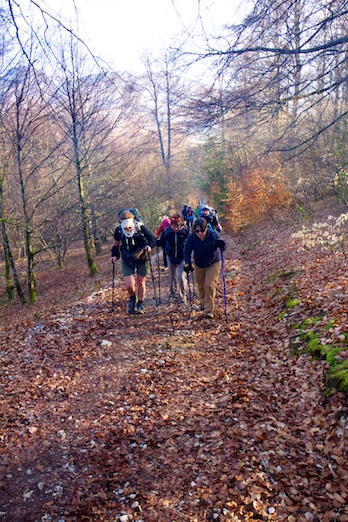
and other days we would see hardly a soul.
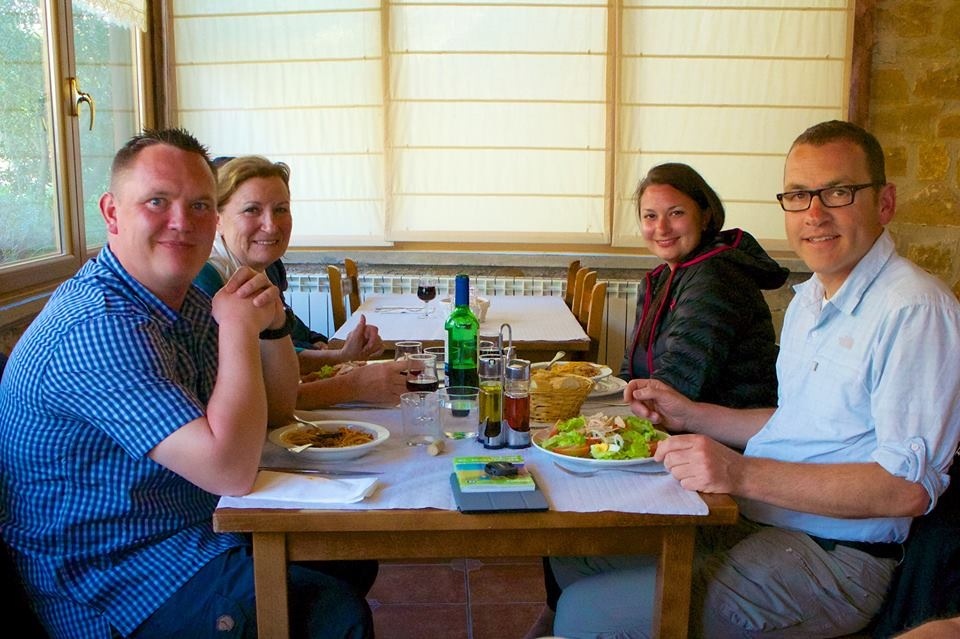
We met some interesting people, bumping into them time after time. We shared very pleasant times with lovely people
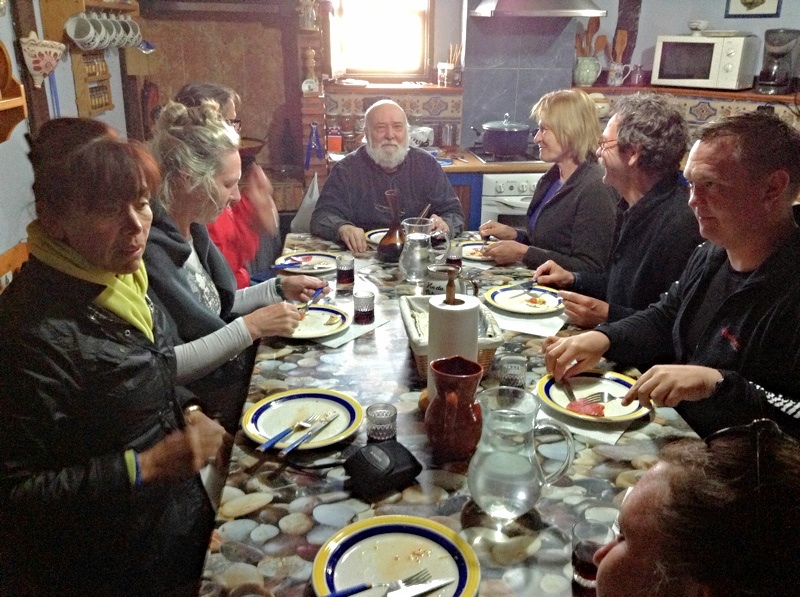
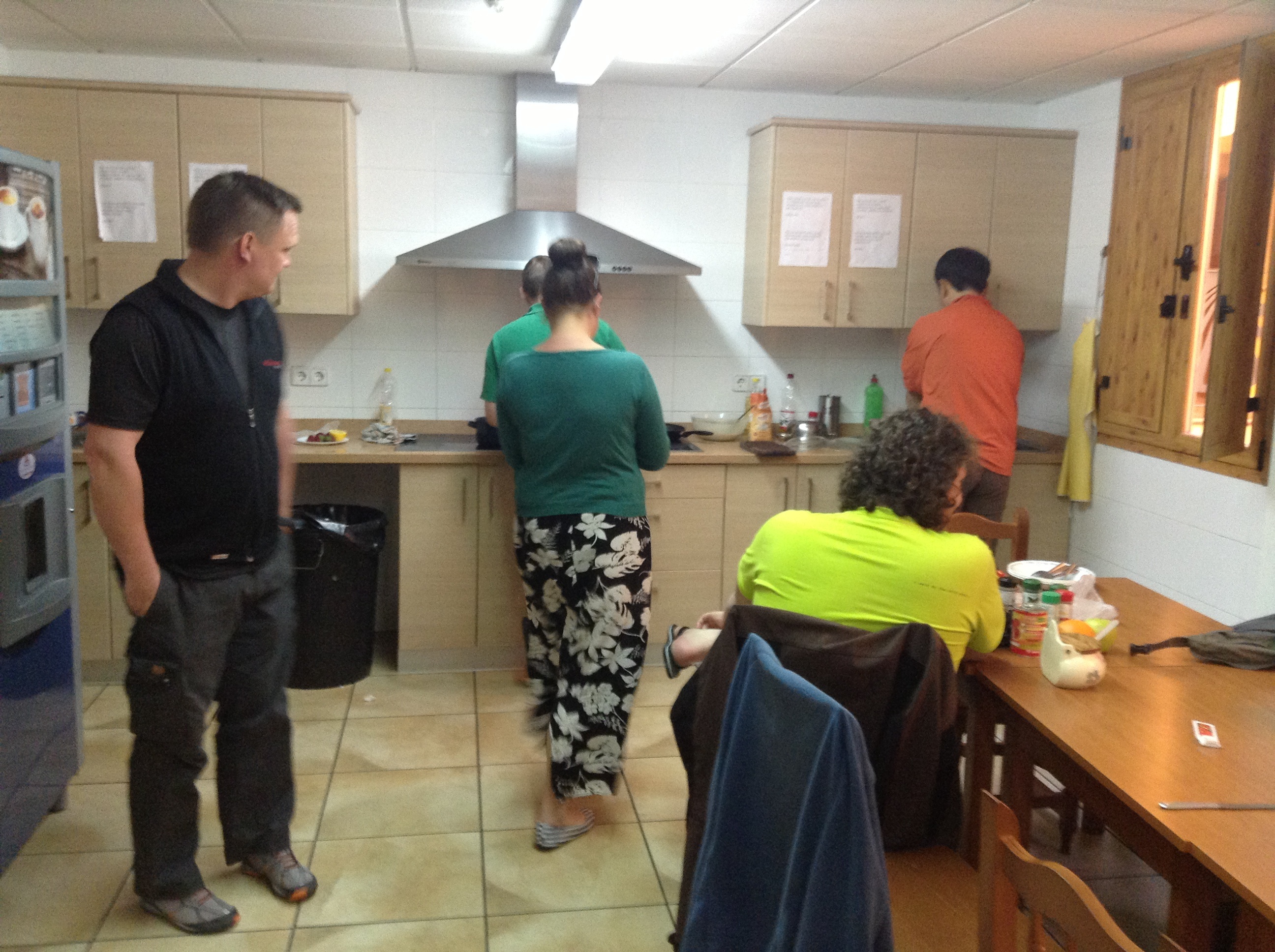
Sometimes the albergues had cooking facilities and Ella would cook dinner for us and anyone else who wanted to join us.
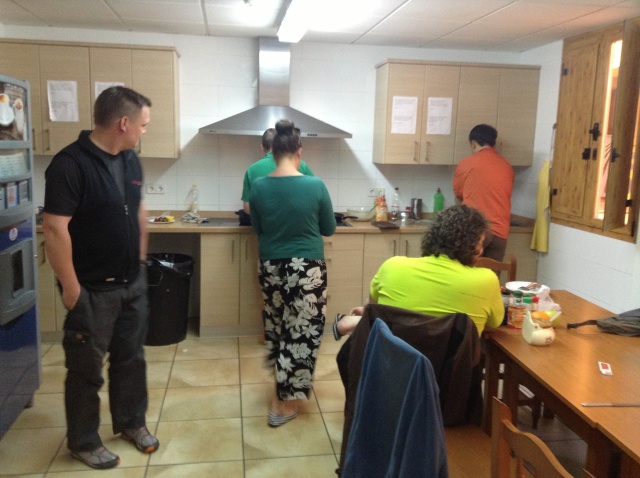
The huge municipal albergue at Santo Domingo de la Calzada, with excellent facilities
Some pilgrims just walked a section of the camino, returning another year to continue. Some pilgrims took buses through certain stages. Some pilgrims didn’t carry their bags, but sent them ahead by taxi.
Ella and I wanted to walk every step of the camino, no matter how difficult or how boring or how ugly it may be. We wanted to carry our packs ourselves. We wanted the complete experience from start to finish.
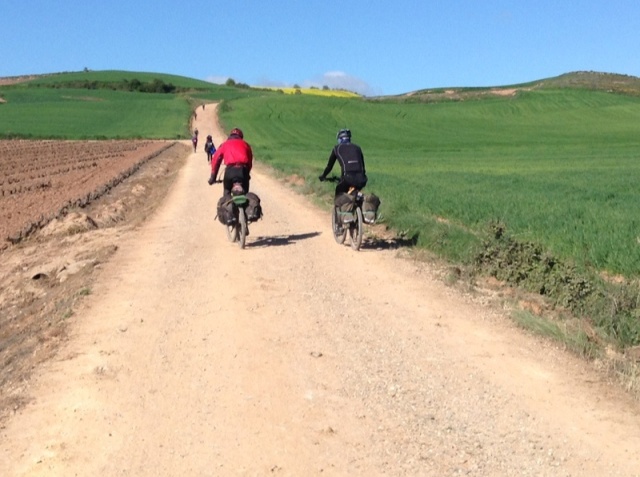
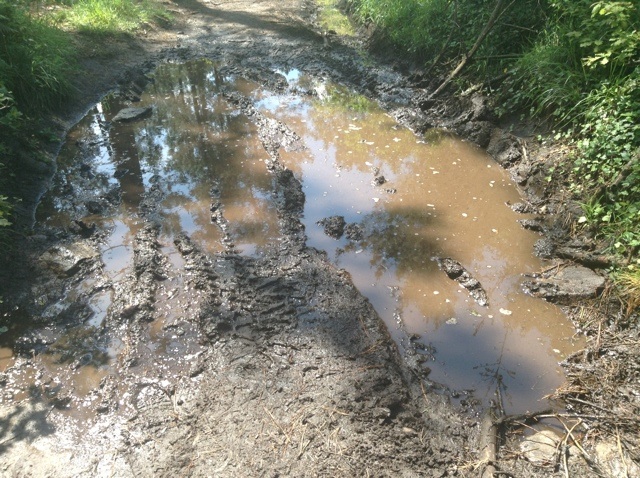
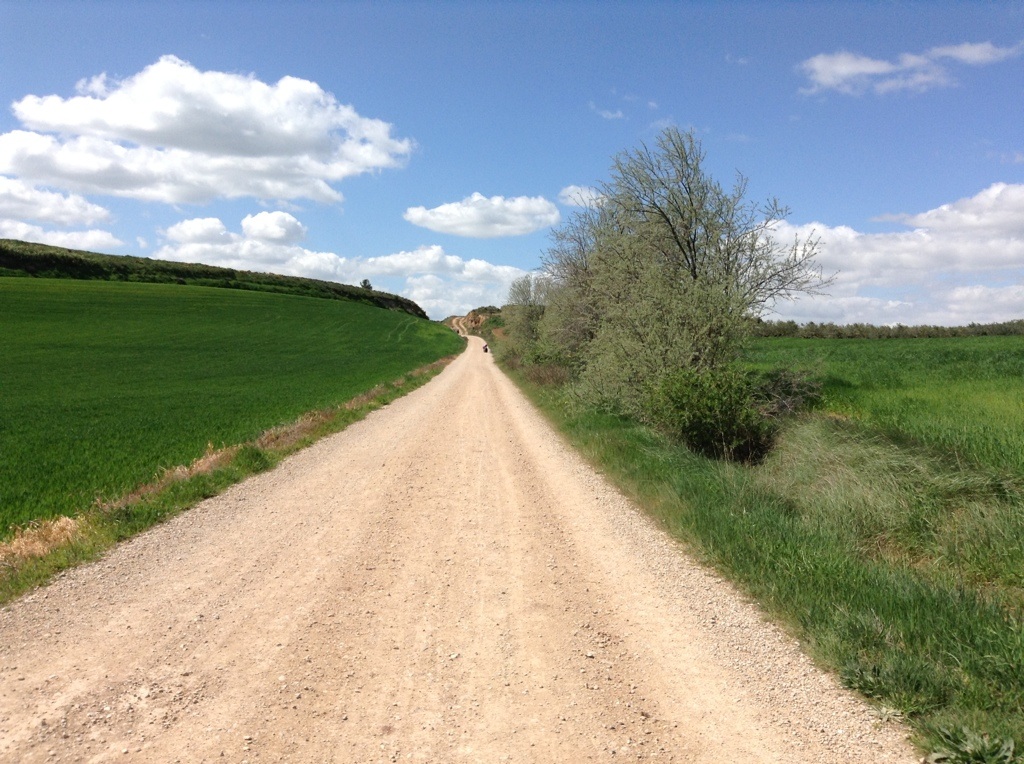
The tracks varied from gravel, to rough and rocky, occasionally they were made of compacted earth or sand which was a dream to walk on, but mostly they were stoney and quite uncomfortable. In places it was extremely muddy. There had been a great deal of rain in the weeks prior to us starting and the paths were either still sloshing with wet mud or dried into deep ruts where bikes had passed over them.
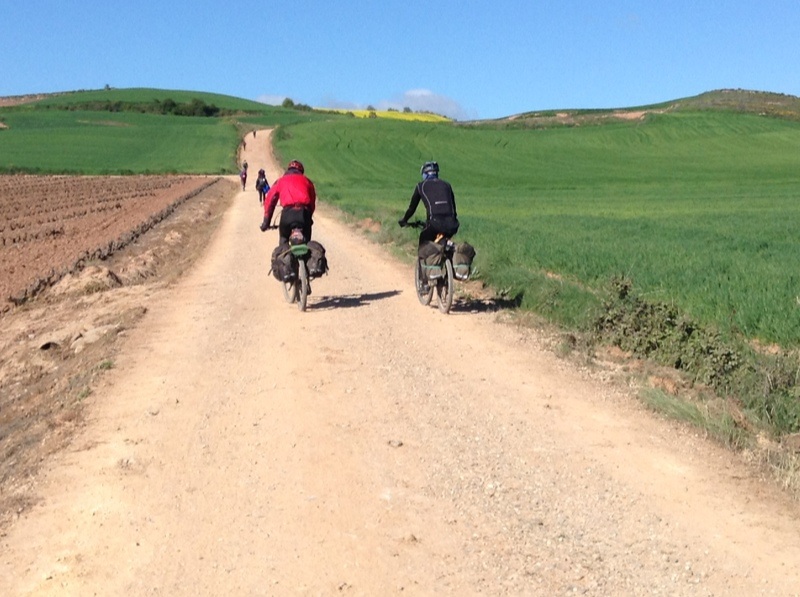
There were a lot of cyclists on the camino, virtually none of whom had a bell on their bike and would come up behind us without any warning and make us jump out of our skins.
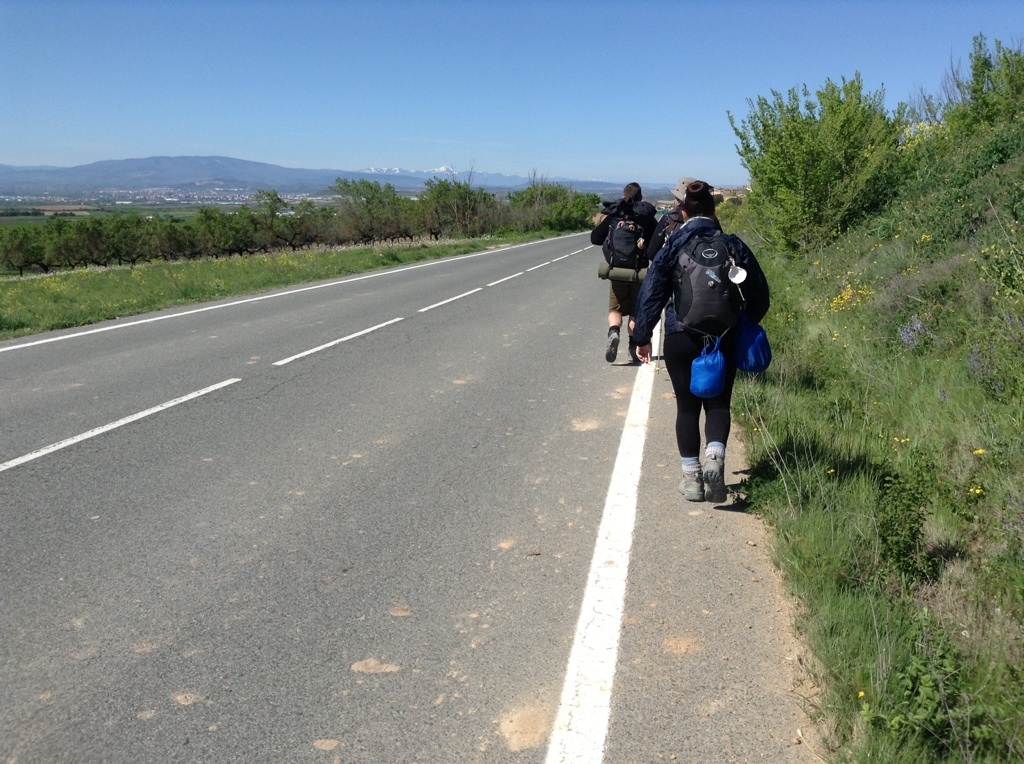
Quite often we had to walk on paved roads, which was ok for short spells, when it was broken up by tracks, but if we were on roads for an extended time it became very wearing on the feet and on our spirits.
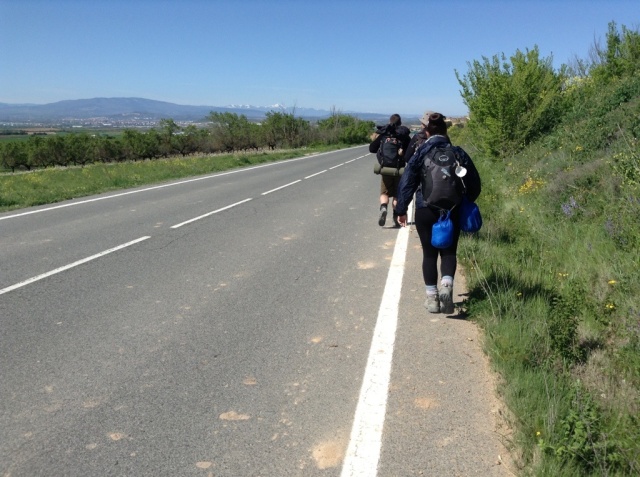
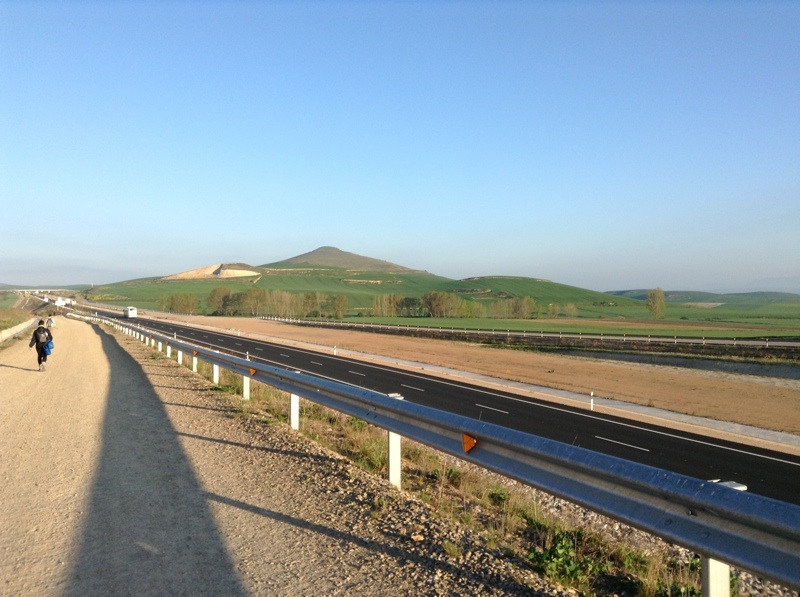
There were also long stretches of pathways alongside the motorway, brightened occasionally be lorry drivers beeping a greeting. The worst day was when we walked through Burgos, traipsing through kilometre after kilometre of industrial and commercial areas to reach the city and then the same again on the way out. Logroño, León and Astorga were also a slog to get through.

We didn’t stop to sightsee in the cities. We were both of the mind that we were on a walk, not a sight-seeing tour and just ploughed straight through, preferring to stay for the night in small villages.

the stunningly beautiful village of Santa Catalina de Samosa
I left all the decisions relating to how far we walked each day to others. First to Peter and Soren, and then Ella took over. Ella’s return flight was booked for 22 May so we worked our way backwards from this point.
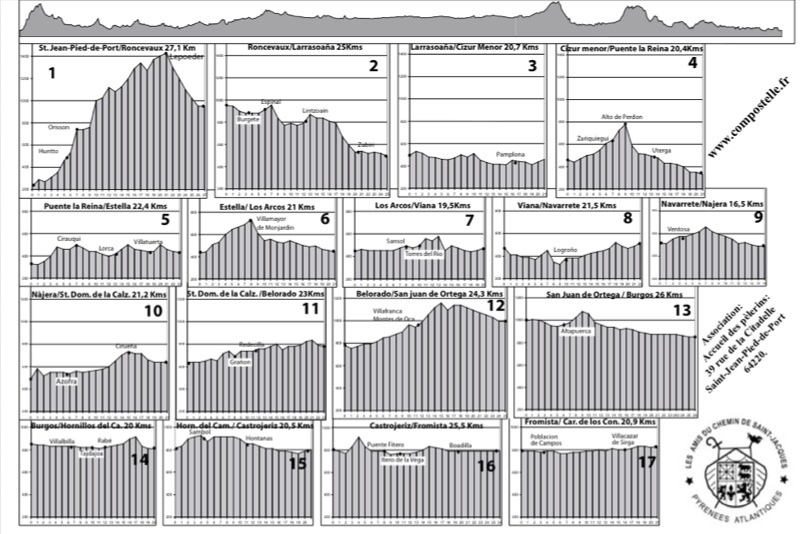
We didn’t take a guide book, relying on a couple of sheets of paper showing the elevation of each suggested stage, and a list of albergues; and also looking at the guidebooks of other pilgrims from time to time.

We didn’t follow the stages suggested every day. We wanted to avoid stopping at the obvious places where there would be more pilgrims.
We walked every day, for thirty-four days, without any rest days. On average we walked 27 km per day, the longest being 37 km and the shortest was 20km.
The scenery and weather could lift flagging spirits. And when I found it really tough going I plugged in my ear phones and listened to good marching music. On a couple of occasions I walked too fast which caused blisters to form under my toes.
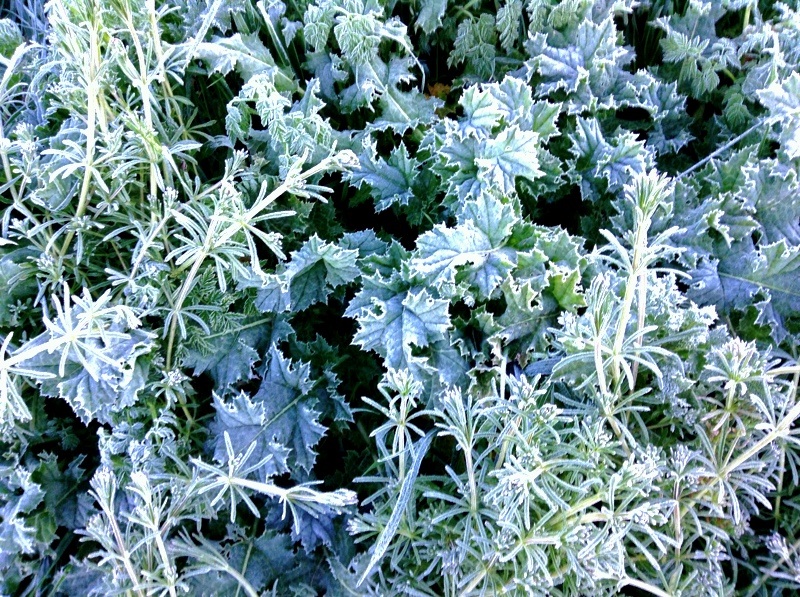
We met with every type of weather. Snow on the ground at the start together with lovely sunshine for a few days. Then drizzle, then howling gales that almost knocked us over, then we had to battle through a hail storm followed by snow and a heavy frost, then severe rain, then a mixture of cloudy sunshine which was ideal walking weather, then back to heavy rain for a few days towards the end of our journey.

a frosty start to the day
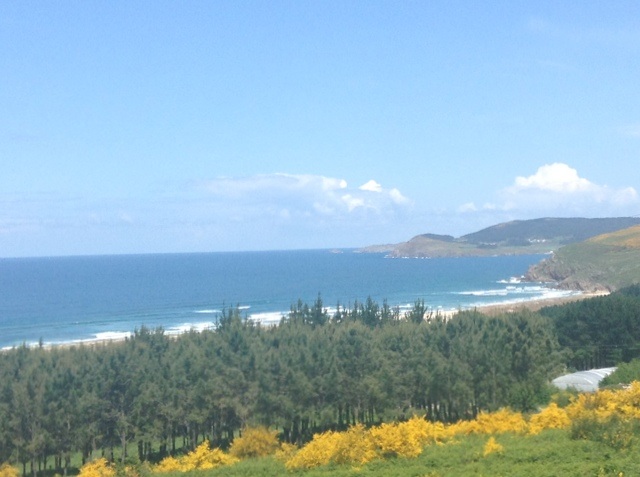
But it was our great good fortune to be greeted with glorious sunshine as we approached the coast and I was able to spend a morning in Finisterre ambling along the beach looking for scallop shells and lying in the sun. Pure bliss.

reaching the ocean at Muxia
Did the experience change me emotionally?
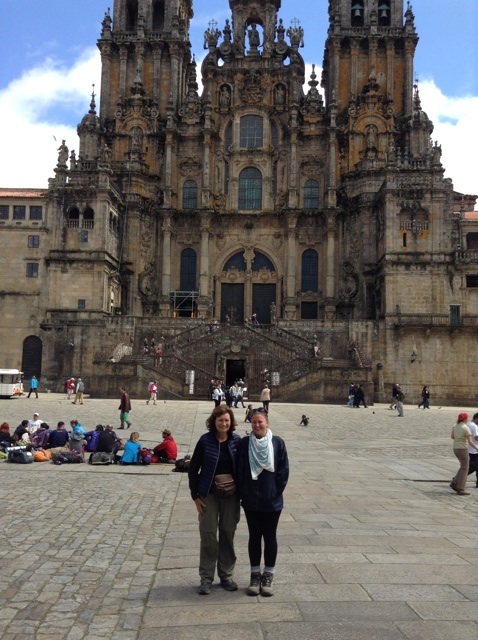
Not really. I had no amazing spiritual or religious awakening, no life changing experiences. But I do feel a bit different, having done something so major. And I did have a bit of a meltdown on entering the cathedral at Santiago for the first time. I was overcome with emotion that we had reached our goal, and collapsed onto a pew in a fit of tears. I loved the cathedral, and the pilgrims’ mass was mesmerising. I was so lucky that the botafumiero was in action at the end of the mass. An amazing experience to behold.

I guess I have changed a little, in that I am now considering walking another camino, probably next year, possibly the Camino Portuguese, from Lisbon to Santiago. And the big difference (and huge leap out of my comfort zone) would be that I will walk on my own. I loved walking with Ella and spending such a chunk of time with her, but it made me very lazy about communicating with others, which is what a lot of pilgrims consider to be the most important aspect of their camino.
I am extremely lucky that I had no restrictions on my time and was able to complete the camino in one go. I think that if I had decided to walk a shorter stage of just a couple of hundred kilometres, it would not have meant as much to me and I doubt that I would have gone back to complete the exercise. It was just perfect timing that Ella invited me to join her when she did and that by the time we had set a date my job had ceased to exist and we were both free to commit to the project.

Physical issues
During my training and the first couple of weeks of the camino, my calf muscles grew enormously, much to my dispair. I hated the chunky look of my legs and thought that I was stuck with it until long after my walk finished. But somewhere along the way the bulk disappeared and my calves returned to normal – very strange.
My back slimmed down a lot, I guess due to carrying my pack and also from using hiking poles. I had serious expectations that the poles would help rid me of the inevitable onset of the dreaded ‘bingo wings’, but unfortuntely I can’t report any changes there!
When I set off I was about 2.5 kilos above the weight I deem acceptable, and 4.5 kilos above my ideal target. I had been trying to shift at least a coupe of kilos for many months without any success. During the walk I ate many more carbohydrates than I would normally, lots of bread, chips, chocolate and beer (which I don’t normally drink) and wine. It was quite difficult to eat healthily on a regular basis, most of what was on offer was stodge to fuel the hungry hikers.
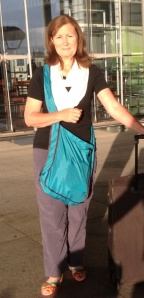
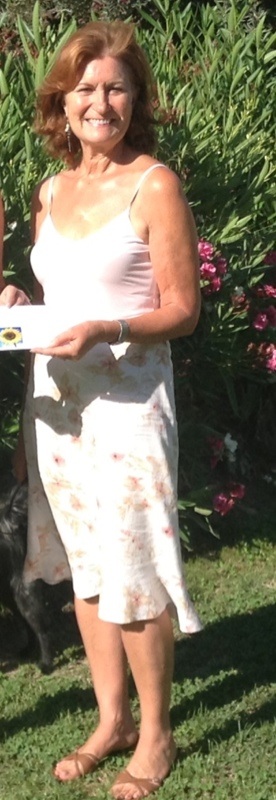
before

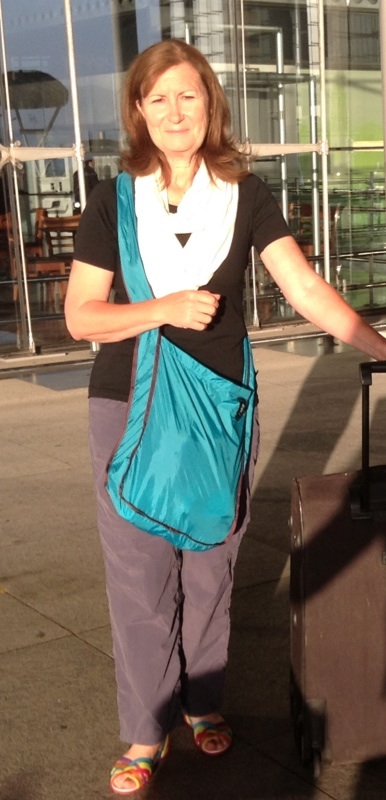
after
I was aware that I had lost some weight because my trousers were very loose, but there was no opportunity to assess yourself in a full length mirror as you would at home. In the event, the difference between my starting and finishing weight was a loss of 6 kilos and then I dropped another kilo during the first week of my return. So, a total weight loss of just over a stone, which I am delighted about, and am maintaining ten weeks on.
My feet have almost recovered. My heels are no longer bruised where I suffered deep blisters, but the underside of my fourth toe on each foot remains quite numb, even after ten weeks. Hopefully this will go in time, but it is not a huge problem. Also, one of my big toes became bruised under the nail and although it has never caused discomfort, I am about to lose the nail. Hopefully it will hold on for another couple of months until I can start to wear closed in shoes.
When I left home my backpack weighed approximately 7.5 kilos, not too much over the recommended 10% of bodyweight. However, during the walk this weight was supplemented by water and food supplies. I also found myself carrying the odd item for Ella because she had no room to put anything extra in her very undersized pack. During the first few days I found the pack very uncomfortable and heavy and was constantly making adjustments to the straps in an attempt to make it less of a burden. But over time the pack became less of an issue, presumably my back and shoulders were becoming stronger, and eventually I was hardly aware of the weight until I took it off.
During the first week I was walking with Ella, who has lived out of a backpack for years, and with Peter and Soren who are both experienced hikers and used to all the equipment. They were all able to get ready in the morning with seemingly no effort. As a complete novice I hadn’t thought that it would be useful to practise packing and organising my pack, and as a result I was always in a panic in the mornings, not wanting to hold everyone up. But I was always last to be ready, no matter how much earlier I had risen.
On a very personal note, like many women of my age, I suffer with a very sluggish digestive system. This is fairly easy to deal with at home, by eating plenty of fibre, taking fibre supplements and when the need arises taking a laxative. However it is extremely nerve wracking to take a laxative when you don’t know that a loo will be available for use at the right time. In conjunction with the terrible stodgy diet enroute, I did suffer a degree of discomfort and bloating.
Who else walks the camino?
People from many different countries make this pilgrimage, many repeating the experience several times. It can be addictive.
Here are some facts and figures:
During May 2013 (the month that we completed our camino) the following numbers of pilgrims registered their camino and claimed their compostela certificate at the pilgrims’ office in Santiago:

Total number 25,206
of these 46% were women and 54% men
87% arrived on foot, 12% by bicycle, 0.5% on horseback and 0.03% by wheelchair
13% were under 30, 60% were aged between 30 & 60 and 27% were over 60
32% were spanish, and 68% foreigners.
of the foreigners 20% were german, 10% French, 9% Italian, 9% from the UK, 6% Portuguese, 5% Irish.
We also came across many Americans, Australians, Dutch, Danish and Koreans
71% of pilgrims chose to walk the Camino Frances although there are various other routes
and of these, 20% started their camino in Sarria, the shortest route that allows a compostela to be granted at just over 100 km
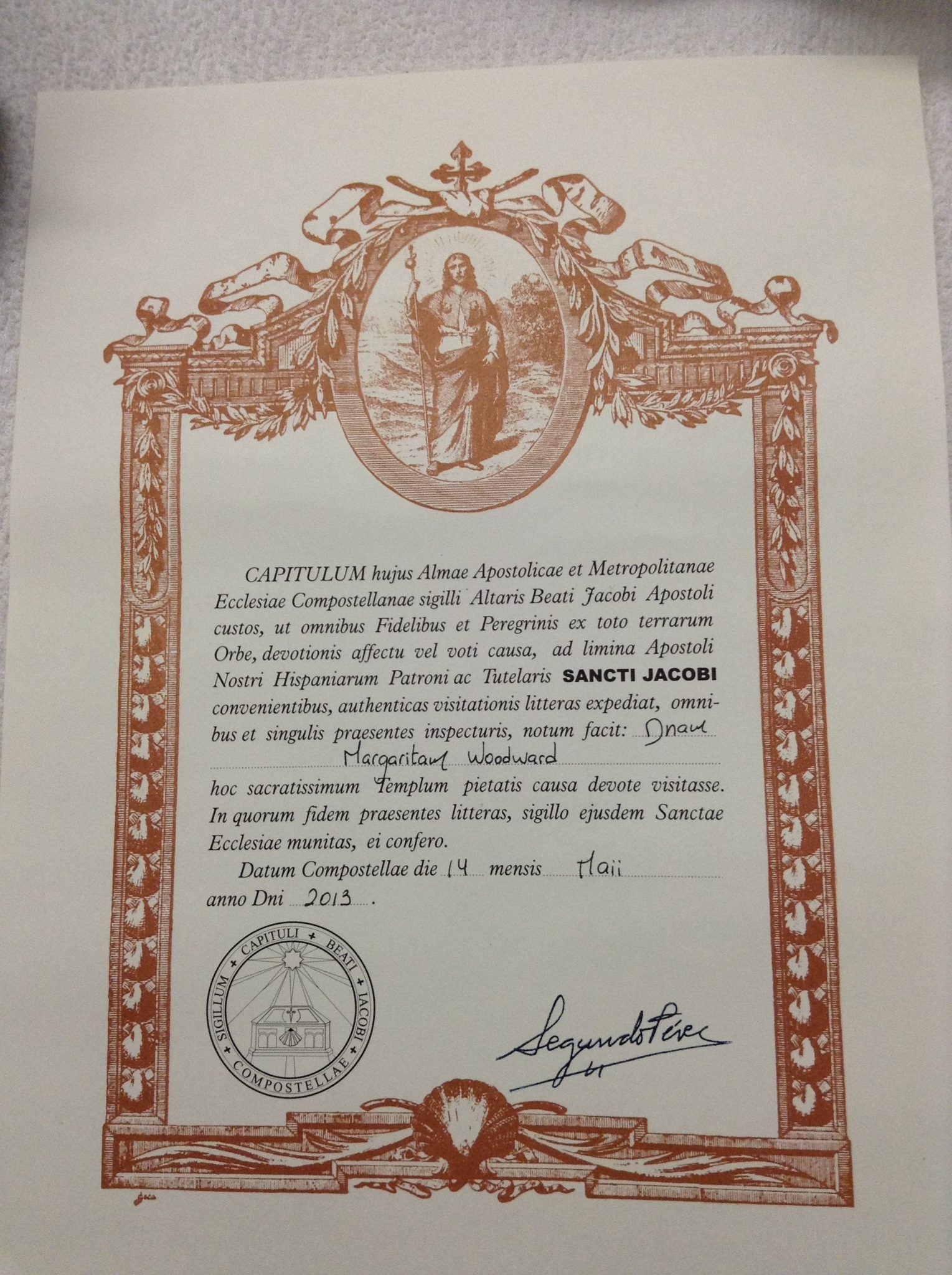
15% started in St Jean Pied de Port, as did Ella and I, walking 800 km to Santiago and then a further 110 km to Muxia and Finisterre where we were able to claim further certificates.
So, why did I do it?
Mainly because my daughter asked me, she wanted to spend this time with me, which is really the only reason I needed.
For the main part, we got on very well, with just one upset during the first week which was over very quickly.

We didn’t have the same walking pace, and as you can see from the photos, Ella is always in front of me, quite often out of sight.
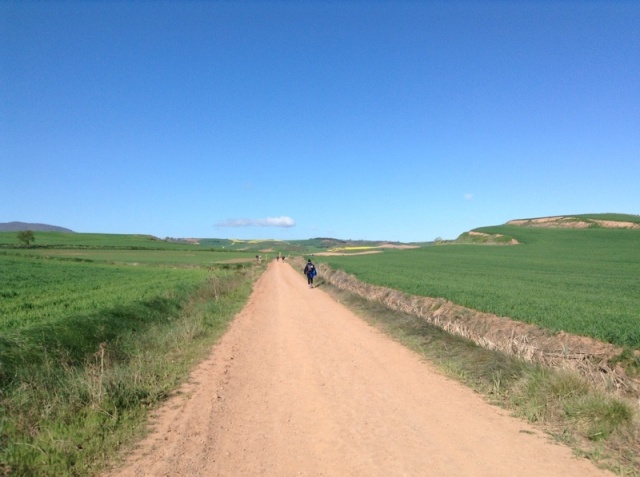
I found this difficult at first, but soon realised that we were both happiest walking at our own pace.
We would start the day together and if Ella got a long way ahead, she would usually wait for me to catch up, and we always ended the day together.
I sometimes found it frustrating that Ella was a bit laid back about setting off in the morning, when I would have preferred to get underway sooner, but it never got to be a problem.
I also found it difficult that she didn’t want to take regular breaks, saying that it hurt too much to get going again. Eventually we found some middle ground and I insisted that we take a break when I was running on empty.

I found I had a lot more strength than I had previously given myself credit for. I could keep going when I felt exhausted and usually the extra distance wasn’t actually so hard as I expected.
An extra 5km at the end of a long day could be done without too much of a struggle.
My daughter and I are quite insular people and although we spent so much time together, either chatting happily or in comfortable silence, I don’t feel our relationship has changed in any profound way. It has always been good and has remained so.
But I feel so honoured that she wanted to share this adventure with me.
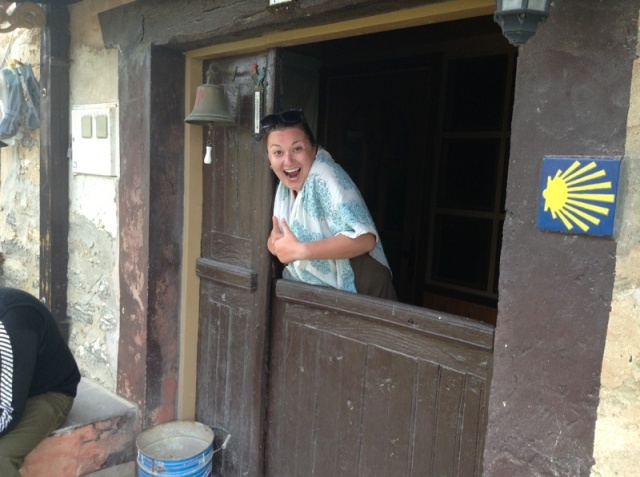
Ella will not be amused that I included this photo, but I love it!
I worked hard at writing my blog every evening, so that nothing can be forgotten, and I will have these wonderful memories fresh in my mind forever.
Things I missed on the camino
Privacy – having to attend to personal matters amongst a crowd of people. This was one of the things I really dreaded before embarking on my walk. It was not so bad in reality, I had to just get on with it and assume that no-one was really interested in what I was doing.
Freedom – which was available in abundance when walking. But in the albergues, the freedom to act as you would in your own private space didn’t exist
Physical contact – I missed the physical proximity of my household. Obviously I missed David, and I also missed the hands-on contact with my animals.
My bed – Oh how I missed stretching out in bed with the freedom to sprawl and turn over without getting tied up in knots by a sleeping bag and liner. I used a ‘mummy’ style sleeping bag to save space and weight, but I would not choose to use one again.
Good healthy food – there seemed to be a diet of pasta and chips on the camino, and hardly a vegetable in sight. It was a real relief when we could prepare food for ourselves.
Hair conditioner – 2 in 1 shampoo is no substitute for conditioner. There are some restrictions in weight that are a cut too far.
Hair straighteners – but however much I desperately wanted them, there was not really time to worry about my frizz and not many opportunities to look in the mirror and stress about it.
and a few of the things that I learned
How wonderful it is to have the support of your friends and family. The comments on my blog were uplifting and provided a real boost for me.
Don’t rely too much on printed information. Lists of albergues included those that were closed. Almost every guide book and map indicated different distances between stages.
If you do enough exercise you can eat lots of chocolate
Wifi is absolutely essential to my well being.
Walking uphill only hurts until you reach the top and then, whilst you are recovering your breath, you can admire the wonderful views from “on high”
I am a lot stronger than I gave myself credit for
Raincoats are not waterproof when wearing a back pack.
It doesn’t matter if you look ridiculous, a rain poncho will keep you dry. By the time I realised this it was too late – there were no more shops.
In normal life I would have to admit to being a little vain, usually making an effort to look my best when I leave the house. But on the camino this was not possible, it was just a matter of keeping my hair tied up and off my face. However my most important packing extravagance was an illuminated magnifying mirror and a pair of tweezers
What would I do differently?
I would take a Brierly guide book.
Happily carry the extra weight to take a camera. The ipad mini was fabulous for so many things, including most photos, but I missed the ability to zoom in on subjects.
I would take different relaxing clothes.
I would search out more interesting albergues, not just stay in the first one with beds available. We did tend to worry about availability, probably unnecessarily.
Take a bigger supply of quality tape for my feet.
But overall I think I got it just about right.

sitting in the park above Santiago de Compostela with the spires of the cathedral in the background
I have rather belatedly realised that I can easily adjust the size of photos in my blog. I would appreciate some feedback – do you think the photos in this post are too big?
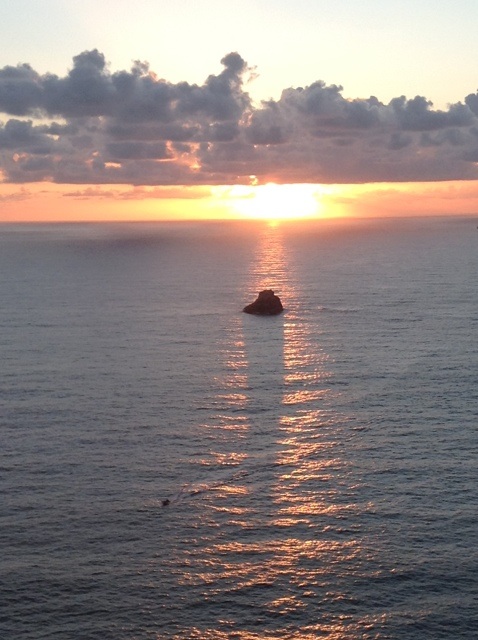
the sun sinking into the ocean at the ‘end of the world’ – Finisterre
























































 Trepidatious traveller - camino blog